
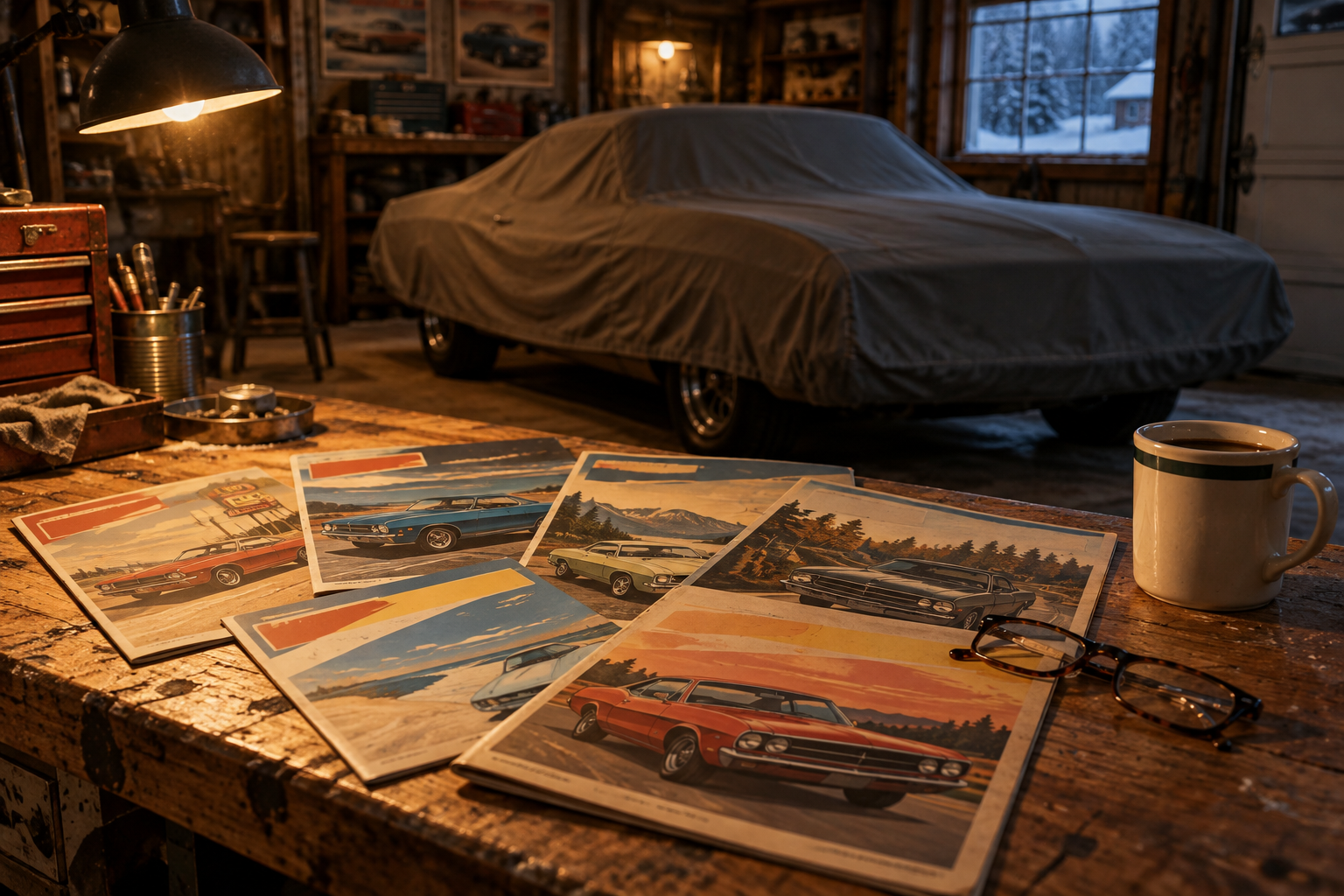
My muscle car went to sleep two weeks ago. I wrote about that whole ritual in last month’s winter storage guide, and I will not repeat it here except to say that the fuel is stabilized, the battery is on a maintainer, and the cover is on. Until April, the only driving I will do in that car is on paper.
Which is fine, because November is when I go back to the paper. In a cabinet in my office in New Canaan there is a stack of 1960s and early 1970s car magazines, dealer brochures and tear-sheet advertisements that I have collected over the years. On a dark evening, with the first snow coming, I will pull a few out and read them the way other people read novels. And every year the same thought lands on me a little harder: the cars were built in Detroit, but the legend was written on Madison Avenue and in the ad agencies along Woodward Avenue.
That is the angle I want to take this month. Not the engines, not the quarter-mile times, not which car was "first" — I have done plenty of that on this site, including my look at the role of muscle cars in American automotive history. This is about the men who sold them. As the CEO of an accounting firm, I find it one of the most instructive marketing stories in American business, and it is also just a terrific yarn.
The Problem the Ad Men Had to Solve
Here is the setup. In the early 1960s, General Motors wanted nothing to do with racing. Corporate policy said performance was off limits, and the divisions were expected to sell sensible family cars to sensible family buyers. Pontiac, in particular, had spent the 1950s with a reputation as an old man’s car.
At the same time, the Baby Boom was coming of age. Millions of young Americans were about to get driver’s licenses, first jobs and first car loans, and they had no interest in their father’s Pontiac. The engineers understood this. The problem was that the corporation would not let them say it out loud.
Into that gap stepped a generation of advertising men who figured out how to sell performance without ever quite being allowed to. The most famous of them was Jim Wangers, an account executive at the Detroit agency McManus, John & Adams, which handled Pontiac. Hagerty’s obituary of Wangers tells the story well: he had already made his name at Chevrolet in 1955 with "The Hot One" campaign, built on privateer NASCAR wins, and he arrived on the Pontiac account in 1958 with a very clear idea of what young buyers wanted.
Wangers was also, importantly, a racer. He drove a Pontiac Catalina to the NHRA Top Stock Eliminator title in 1960, and Motor Authority’s profile makes the point that this gave him one hand on the pulse of the street and the other on the pulse of the engineering department, through his close relationship with Pontiac’s chief engineer, John DeLorean. He was not a marketing man guessing what enthusiasts wanted. He was one of them.
The Greatest Magazine Stunt in Automotive History
When Pontiac’s engineers found a way to slip a 389-cubic-inch V8 into the midsize Tempest LeMans as an option package for 1964, they had a car but no permission to promote it as what it was. Wangers solved that with a single magazine cover. I have written before about the legendary Pontiac GTO, so I will keep the car itself short and focus on how it was sold.
The March 1964 issue of Car and Driver carried a cover that pitted the new Pontiac GTO against the Ferrari 250 GTO, the car whose name Pontiac had borrowed. The two cars were never actually on the same track together. The article was a road test of the Pontiac, dressed up as a comparison, and it was wildly enthusiastic. The cover line claiming zero to 100 miles per hour in under twelve seconds did more for the GTO than any paid advertisement could have.
There was a catch, and Wangers admitted it decades later. The test car had been quietly fitted with a larger 421-cubic-inch engine that looked identical to the stock 389, and it had been tuned by Royal Pontiac, the dealership that served as Pontiac’s unofficial performance arm. The car was a ringer. Twenty years later, in 1984, Car and Driver staged the real comparison with Dan Gurney driving both cars at Laguna Seca, and the Ferrari won going away.
I bring up the ringer not to tarnish the man but because it is the most honest part of the story. The campaign worked. Pontiac sold more than 32,000 GTOs in that first year against internal forecasts of a few thousand, and the muscle car era had its origin myth. But the trick only worked once, and Wangers knew it. Later in his career he founded Automotive Marketing Consultants Inc., a company whose entire business was independently certified performance testing, so that "best in class" claims in advertisements could be documented. The man who pulled off the most famous bit of automotive sleight of hand spent the back half of his life making sure claims could be proven. There is a lesson in that for anyone who runs a company.
Beyond the Printed Page
What strikes me most, reading those old magazines, is how far ahead of their time the Pontiac campaigns were. Wangers did not think of the GTO as a car to be advertised. He thought of it as a brand to be placed everywhere a young buyer might be looking.
He had a hand in the 1964 hit single "G.T.O." by Ronny & the Daytonas, which was, for all practical purposes, a two-and-a-half-minute radio commercial that people paid to listen to. He arranged for a GTO sweepstakes with the Thom McAn shoe chain in 1966, complete with a "GTO" shoe sold in stores. He put a customized GTO in front of a television audience every week as the Monkeemobile. And when Pontiac launched the GTO Judge in 1969, the name and the entire brash campaign around it were built on a catchphrase from the most popular comedy show on television.
Music, footwear, television, comedy. Today we would call that an integrated campaign with cross-category partnerships and earned media. In 1966 it was just one man with a Pontiac account and a very good instinct for where the attention was.
Chrysler Answers: The Scat Pack and the Rapid Transit System
Pontiac’s success did not go unnoticed across town, and Chrysler’s response is, in my opinion, the most underrated marketing program of the whole era.
Dodge went first. For 1968, with the redesigned Charger and Coronet arriving, the division grouped its performance cars under a single banner, the Scat Pack, and gave them a shared visual identity: a cartoon bee and the "bumblebee" tail stripes. Buyers could join the Scat Pack Club and get decals, jackets and a newsletter. The campaign slogan, "Dodge Fever," turned up everywhere. I covered the Charger’s side of this in my chronicle of the Dodge Charger; what matters here is that Dodge had turned a lineup into a club.
Plymouth’s own answer the same year was the Road Runner, and it remains the single best example of buying attention rather than building it. Plymouth licensed the Warner Bros. cartoon character, paid extra for the rights to the "beep beep" horn, and sold a stripped, cheap, fast car to young buyers who got the joke instantly. The car outsold every projection.
Then, for 1970, Plymouth went bigger. Hagerty’s piece on the Rapid Transit System cars lays out the program: advertisements built around factory-backed drag racers like Sox & Martin, a parts-and-tuning catalog so owners could make their cars faster, "Supercar Clinics" held at dealerships, and a traveling caravan of specially customized show cars that toured the country on a yellow transporter. The customs were penned with help from Hot Wheels designer Harry Bradley and built by Detroit-area shops like Chuck Miller’s Styline Customs. The tagline was that anybody could offer a car, but only Plymouth offered a system.
Think about what that is. It is not an ad campaign. It is a community, a product ecosystem, a dealer training program and a road show, all under one name. Plymouth was selling membership. And the proof that it worked is in what happened to the caravan cars: when three of them from a single collection crossed the block at Mecum Indianapolis in 2019, the Hemi Road Runner sold for $341,000, more than double what a standard Hemi Road Runner in concours condition would bring. The marketing props became more valuable than the product. I am not sure there is a cleaner illustration of brand equity anywhere in American business.
Ford Sells a Lifestyle, Not a Car
Ford deserves a paragraph too, because Ford took the opposite approach and it also worked. Where Pontiac and Plymouth sold horsepower, Ford sold the Mustang in April 1964 as a lifestyle object. It launched the car at the New York World’s Fair, blanketed all three television networks on the same night, and put young couples and first-job professionals in the advertising rather than drag racers. Ford’s broader "Total Performance" campaign took care of the racing credibility through Le Mans and NASCAR, but the Mustang ads themselves were about who you would become if you bought one. A million Mustangs in under two years says that worked.
I wrote about the designers and executives behind these cars in The Men and Women Behind the Muscle Car Machines. It is worth remembering that for every Bunkie Knudsen or Lee Iacocca there was a copywriter whose name nobody remembers, writing the line that actually moved the metal.
What a CEO Takes From All This
I run 1-800Accountant, which is about as far from a Pontiac dealership as a business can get. But I have come to believe the muscle car ad men got five things right that most companies still get wrong.
- They picked a customer and ignored everyone else. Every one of these campaigns was aimed at buyers under 35. Older buyers were not just deprioritized; they were deliberately left out of the picture. Trying to sell to everyone is how you end up selling to no one.
- They led with proof, not adjectives. The racing results, the magazine tests, the drag-strip clinics. Even the GTO stunt, for all its mischief, was framed as a test. The lesson I took from Wangers’ later career is that the proof has to be real, because the day it is not, you lose the asset you were building.
- They built a club. Scat Pack decals, Rapid Transit catalogs, GTO shoes. The buyer got something to belong to, not just something to own. That is why those owners are still showing up at meets sixty years later.
- They named things well. GTO. Road Runner. The Judge. Scat Pack. Rapid Transit System. Every name did work. Every name was easy to say, easy to remember and impossible to confuse with the competition. Naming is a discipline, and they treated it like one.
- They went where the attention already was. Radio, television, shoe stores, the dealership parking lot on a Saturday. They did not wait for buyers to come to the brochure. That is still the whole game.
Why the Party Ended
Marketing can create a boom, but it cannot repeal arithmetic. By 1970 the insurance industry had figured out exactly who was buying these cars and started pricing them accordingly, with performance surcharges that put a young driver’s premium out of reach. Emissions regulations were tightening, compression ratios were dropping, and the 1973 oil crisis finished the job. The ad campaigns were still clever in 1972; the product underneath them had changed. No amount of sizzle can sell a steak that is no longer on the menu.
That is the sober half of the lesson. The Scat Pack and the Rapid Transit System were wound down almost as fast as they had been built. The brands that survived were the ones with something durable behind the advertising, which is why the Mustang and the Charger are still in showrooms today and the GTO is not.
Collecting the Paper
I will close with a practical suggestion for anyone who loves these cars but is not ready to buy one. Collect the advertising.
Original magazine ads from the 1960s and early 1970s can be had for the price of a lunch. Dealer brochures, especially the big fold-out ones from the 1969 and 1970 model years, run a little more but are still accessible. Dealer promotional films and salesman’s training materials are rarer and genuinely fascinating. I treat mine the same way I treat the cars: climate-controlled storage, acid-free sleeves, out of direct light. As I argued in my piece on muscle cars as alternative investments, the ephemera around a collectible category tends to appreciate right alongside the category itself, and the entry price is a rounding error by comparison.
More importantly, the paper tells you why. You can learn what a 442 is from a spec sheet. You can only learn why a 22-year-old in 1969 wanted one by reading what Oldsmobile told him.
Across My Other Collections
The longer I collect, the more I notice that every one of my hobbies has a marketing story underneath it. Nike built the Air Jordan line on exactly the Pontiac playbook, proof on the court, a club off it, and a name that did the work, and that is a big part of why I collect Jordan sneakers and write about them on my Collections site. LEGO turned a plastic brick into a global brand by selling imagination rather than toys, which I explored in LEGO and the Entrepreneurial Mind on my main site. And on the other side of the ledger, my wife Sandra and I started the Savage-Rivera Foundation precisely because the families we work with in Honduras have never had anyone selling anything to them, or for them. Learning how attention is won is useful whether you are selling cars or raising money for a school lunch program. Even my travel blog is, in a sense, about the places that advertising taught Americans to dream of.
Five Pieces Worth Hunting Down This Winter
If you want to start a paper collection, here are the ones I would look for first.
- The March 1964 Car and Driver with the GTO-versus-GTO cover. The most important single issue of a car magazine ever printed.
- A 1968 Dodge Scat Pack brochure with the bee logo and the full lineup. Charger, Coronet, Dart, Super Bee, all on one spread.
- The 1970 Plymouth Rapid Transit System catalog, the one with the parts, the tuning tips and the dealer clinic schedule.
- Any 1969 GTO Judge print ad. The copy is pure late-sixties attitude and the car is wearing Carousel Red.
- A 1965 Mustang ad from the launch year. Look at who is in the picture and where they are standing. That is the whole Ford strategy in one photograph.
If you have a favorite piece of muscle car advertising, or a story about the ad that sold you on your first car, I would love to hear it. You can find all of my sites and profiles in one place at about.me/savagenewcanaan. Enjoy the reading season. The driving season will come back around.
About the Author
Mike Savage of New Canaan, CEO of 1-800Accountant, founder of Savage-Rivera Foundation. Mike writes about muscle cars at mikesavagenewcanaan.com and about his other collections, travels and charitable work across his family of websites.