
By Mike Savage | New Canaan, Connecticut | April 14, 2026
There are two types of people who buy muscle cars. The first buys with their heart — they find a 1969 Pontiac GTO or a ’70 Chevelle SS454 and they feel something that no spreadsheet can explain.
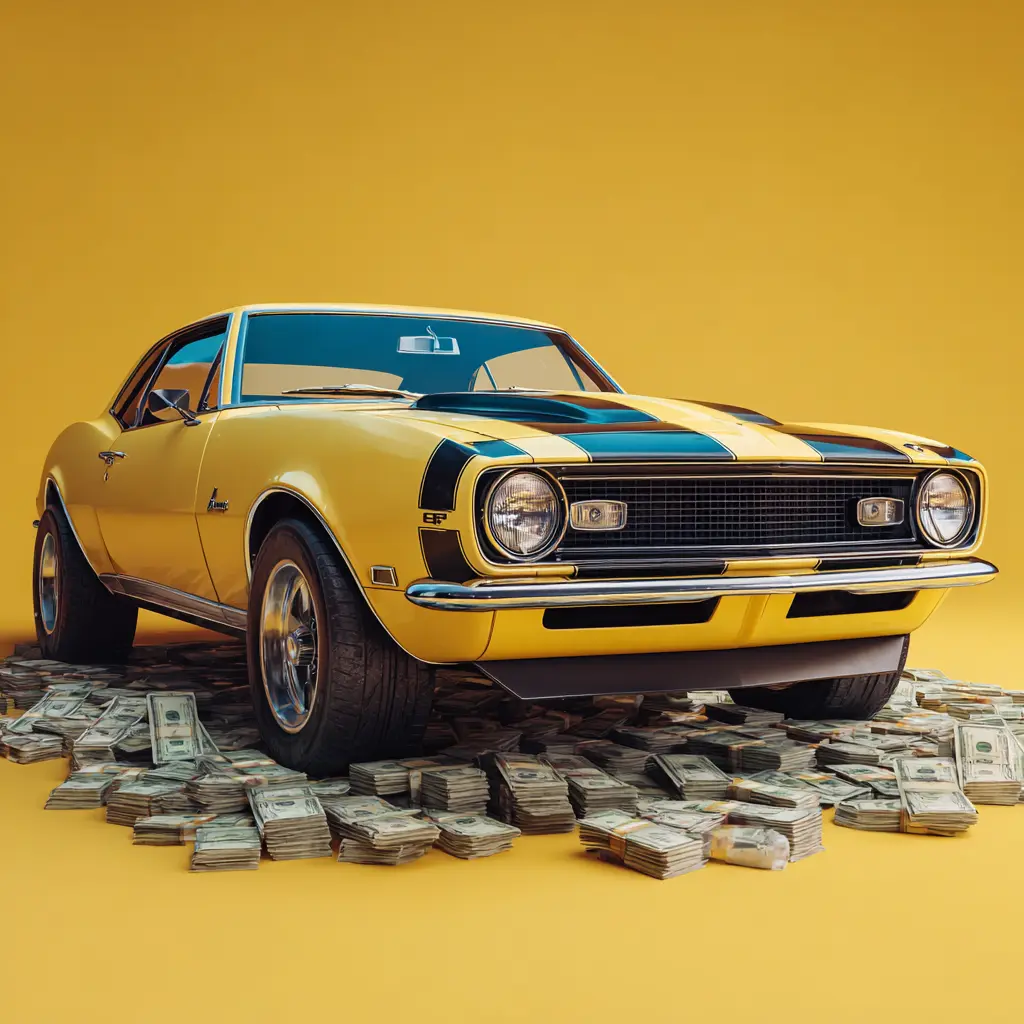
The second buys with both their heart and their head. They understand that certain classic American muscle cars have quietly become one of the most resilient and rewarding alternative asset classes of the past two decades.
I’ve always tried to be the second type. It is also the same strategy that I bring to the idea of collecting LEGO sets as a financial investment.
After spending years in the accounting and financial services world as the founder of 1-800 Accountant, I have a hard time separating my love of these machines from my instinct to understand what drives their value — and what could erode it.
This is what I’ve learned.
Why Muscle Cars Belong in the Alternative Investment Conversation
When most people think of alternative investments, they think of private equity, hedge funds, real estate, or perhaps fine art. Classic muscle cars rarely make the list, and that is exactly what makes them interesting. The Hagerty Vehicle Rating, the most widely recognized index for collectible car values, has consistently demonstrated that blue-chip muscle cars — particularly low-production, documented examples from the 1964–1972 era — have outperformed the S&P 500 in multiple rolling ten-year windows. While past performance never guarantees future results, the underlying dynamics of the market are compelling: a fixed and shrinking supply of original cars, a growing collector base, and a deeply emotional cultural attachment that transcends generations.
Unlike fine art, which can be opaque in its pricing and difficult to transport, a great muscle car has a broad, active secondary market with transparent comparable sales data. Every Barrett-Jackson auction result is publicly catalogued. Every Mecum lot that crosses the block has a hammer price. This gives serious collectors a level of price discovery that many alternative assets simply cannot match.
“The cars I consider investment-grade share three qualities: rarity, documented provenance, and emotional resonance with a broad audience. Miss any one of those, and you have a passion purchase. Hit all three, and you have an asset.”
— Mike Savage, New Canaan, CT
What Makes a Muscle Car Investment-Grade?
Not every classic car appreciates. In fact, most don’t — not meaningfully. The difference between a car that holds value and one that quietly depreciates in your garage comes down to a handful of factors that any serious collector should understand before writing a check.
1. Original Numbers Match
A “numbers-matching” car is one where the engine, transmission, and other major drivetrain components still carry their original factory-stamped codes that correspond to the vehicle identification number (VIN). In the muscle car world, a numbers-matching 1970 Plymouth ‘Cuda with a 426 Hemi engine is an entirely different asset than the same car with a replacement motor — even if both look identical from twenty feet away. The numbers-matching premium can easily represent 30 to 80 percent of a car’s value. Never buy without verifying.
2. Documented Build Sheet and Broadcast Sheet Provenance
The original factory build sheet — sometimes found tucked under the rear seat or inside a door panel — lists every option the car was ordered with from the factory. This documentation eliminates guesswork about whether a high-value option package is original or retrofitted. Auction houses and serious buyers place enormous value on a complete paperwork trail: title history, restoration receipts, show records, and any media coverage the car has received. Treat your investment like a business asset and keep meticulous records.
3. Low Production Numbers
Supply is the single most powerful driver of long-term muscle car value. A 1969 Camaro ZL1 — of which only 69 were produced — will always command a different market than a standard 1969 Camaro. Before purchasing any car as an investment, research the Marti Report (for Ford products), Pontiac Historical Services, or the relevant marque registry to understand how many of that exact car were actually built. Some configurations that appear rare are not; some that appear common are genuinely scarce. Do the homework.
4. Condition Grade
The auction and collector community uses a standard grading scale from 1 (show-quality, essentially flawless) to 6 (parts car). Investment-grade muscle cars are typically Condition 1 or Condition 2. The jump in value between a Condition 2 and a Condition 1 car can be dramatic, but so can the cost of getting from one to the other. A professional restoration by a highly regarded shop can run six figures on a complex project. As I’ve explored in detail in my complete guide to first-time muscle car restoration projects, the restoration process involves far more decision-making than most newcomers anticipate — and those decisions directly impact what the finished car is worth.
| Highest Investment-Grade Muscle Car Categories (2024–2026 Market) |
| → 1970 Plymouth ‘Cuda — 426 Hemi, convertible configuration |
| → 1969 Camaro ZL1 — ultra-low production, documented examples |
| → 1969 Dodge Charger Daytona — Winged Warriors with factory documentation |
| → 1967–1969 Shelby Mustang GT500 — numbers-matching, original drivetrain |
| → 1970 Chevelle SS454 LS6 — documented factory 450hp cars |
| → 1969 Pontiac GTO “The Judge” — Ram Air IV, rare color/option combos |
| → 1970–71 Buick GSX — Stage 1 cars with factory build documentation |
Buying Strategy: Auctions vs. Private Sales
The two primary channels for acquiring investment-grade muscle cars are major collector auctions and private sales. Each has distinct advantages and risks that a financially-minded collector needs to weigh carefully.
Major auction houses like Barrett-Jackson and Mecum Auctions offer the advantages of competitive price discovery, professional vehicle inspections, and broad bidder pools. These venues set the public market — when a well-documented Hemi ‘Cuda crosses the Barrett-Jackson block, the result instantly becomes a comparable sale that affects the perceived value of every similar car in the country. The downside: buyer’s premiums typically run 10 to 13 percent, and the competitive atmosphere of a live auction floor can push prices beyond rational valuations, particularly when two well-funded bidders get emotionally invested in the same lot.
Private sales, by contrast, can yield better pricing — but they require significantly more due diligence. Without auction house vetting, a buyer must independently verify the car’s provenance, condition, and title history. Pre-purchase inspections by a respected marque specialist are not optional; they are essential. I would never purchase a private-sale investment-grade car without having it inspected by someone who has spent decades specifically with that make and model. The savings you negotiate off auction price can evaporate quickly if you miss something an expert would have caught immediately.
The Role of Valuation Tools and Market Data
Serious collectors track the market the way serious investors track equities. The Hagerty Valuation Tools platform is the industry standard for researching condition-graded value ranges across thousands of collectible vehicle makes, models, and years. It aggregates private sales data, insurance replacement values, and auction results to give you a defensible range of what a given car should realistically sell for. Before entering any significant negotiation, I spend time in Hagerty’s database — not to find a magic number, but to understand the spread between what optimistic sellers expect and what the market actually supports.
Beyond Hagerty, pay attention to the rolling results from major auction events. A single standout result — one car that sells for 40 percent above estimate — tells you more about one motivated buyer than about the broader market. Look for patterns across multiple sales, across multiple auction seasons. And be cautious of the narrative that surrounds a particularly hot result. Market enthusiasm is not the same as market depth.
It’s also worth noting that the muscle car market is not immune to broader economic forces. In my analysis of recent shifts in the muscle car market, I noted that rising interest rates and softening discretionary spending have created both headwinds and genuine buying opportunities — particularly for cars in the middle tier of the market that got swept up in the post-pandemic collector car boom and are now returning to more rational price points.
Insurance: The Agreed Value Imperative
This is the aspect of muscle car ownership that I feel most strongly about from a financial protection standpoint, and it is the one most commonly handled incorrectly by new collectors. Do not insure an investment-grade muscle car with standard auto insurance. Standard policies insure cars at their Actual Cash Value (ACV), which accounts for depreciation and will never adequately compensate you for a total loss on a collectible vehicle.
Specialty collectors’ insurance — offered by carriers like Hagerty, Grundy, and American Collectors — insures your car at an Agreed Value that you and the insurer establish together, based on documented appraisal. If the car is totalled or stolen, you receive the full agreed amount, not a depreciated payout. The annual premium on this type of coverage is typically far lower than standard auto insurance, and the protection is categorically superior. For any car worth more than $25,000, this is not optional — it is essential financial hygiene.
Pair your agreed value insurance with proper storage: a climate-controlled, dehumidified space is not a luxury for investment-grade cars. Temperature cycling and ambient moisture are among the most persistent enemies of sheet metal, rubber seals, and original paint. As I discuss in my guide to essential maintenance for muscle car owners, consistent environmental conditions are one of the most cost-effective ways to protect long-term value — far cheaper than addressing damage after it occurs.
The Modification Question: When Upgrades Hurt Value
One of the most common mistakes I see new collectors make is improving a car’s performance at the expense of its investment value. There is nothing wrong with enjoying and driving your muscle car — in fact, these machines were built to be driven, and I encourage it. But modifications that are not period-correct and reversible can meaningfully reduce a car’s resale value with serious collectors.
An investment-grade car should remain as close to original factory specification as possible. If you want to drive the car aggressively, consider installing period-correct upgrades using the same or equivalent parts that would have been available in the car’s era, and always keep the original components. I’ve covered this topic in depth in my post on muscle car modifications and aftermarket upgrades — but the core principle for investment cars is this: every modification you make should either be invisible to an informed inspector, or it should be fully reversible with original parts retained.
The Long View on Muscle Car Values
The collector car market, like any market, moves in cycles. What separates the serious collector from the speculator is the ability to hold through a down cycle without being forced to sell. This means buying only what you can afford to own for a decade, insuring it properly, maintaining it correctly, and letting the fundamental scarcity economics of truly great cars do the long-term work.
The cars that have most reliably appreciated over a twenty-year horizon share a common profile: they were produced in small numbers, they represented the pinnacle of their manufacturer’s performance engineering in their era, and they carry the kind of emotional weight that connects to a large, passionate audience. The most iconic American muscle cars — the ones that defined an era — are not going to get less rare with time. Every year, the pool of original, unmodified examples shrinks further. The collector community, meanwhile, continues to grow as younger enthusiasts discover what made these machines extraordinary.
For me personally, the muscle cars in my collection will never be purely financial assets — the experience of driving a well-tuned big-block V8 on an open Connecticut back road is something that no balance sheet can capture. But understanding the investment dimensions of what I own makes me a better custodian of these cars. It drives better storage decisions, better insurance choices, and a deeper respect for originality and provenance. The financial and the passionate are not in conflict. In fact, in the world of serious muscle car collecting, the best-preserved cars are almost always the ones owned by people who loved them most.
If you are considering your first investment-grade purchase, take your time, do your research, and buy the best example you can afford rather than a lesser car at a lower price point. In this market, quality is not just aesthetically superior — it is financially superior. The gap between a good car and a great car has never been wider, and the great cars have never been more sought after.
********
About Mike Savage Mike Savage is a New Canaan, Connecticut resident and the founder and CEO of 1-800 Accountant, one of the nation’s largest virtual accounting firms serving more than 200,000 small businesses. A 2018 Glassdoor Top CEOs honoree, Savage began his career at PricewaterhouseCoopers before building a firm dedicated to making expert financial services accessible to entrepreneurs. Away from the office, he is a passionate muscle car collector and enthusiast, a dedicated koi pond keeper, a lifelong LEGO builder, and — alongside his wife Sandra — the co-founder of the Savage-Rivera Foundation, which provides clothing, books, and essential goods to families in need in Honduras.