
By Mike Savage
There is a particular kind of quiet that settles over a swap meet in September. The big summer auctions are behind us, the numbers have been printed and argued about, and the people still walking the rows are the ones who actually intend to buy something. That is when I do my best thinking about value — not in the middle of a bidding war under the lights, but afterward, when the market has stopped shouting.
I have spent a long time now looking at muscle cars the way I look at a balance sheet. Twenty-plus years of building 1-800Accountant taught me that the price of a thing and the worth of a thing are two different numbers, and that the gap between them is where every good decision lives. Right now, that gap is unusually wide in the American muscle car market. The blue-chip cars — the Hemi convertibles, the ZL1 Camaros, the documented Ram Air IV Judges — are priced exactly the way you would expect a globally recognized asset to be priced. Everything standing next to them is not.
That is what this piece is about. Not the cars that are cheap because they are bad, but the cars that are cheap because of an accident of badging, body style, model year, or decade. Below are the ones I think represent the most real value on the market as of late 2026, and, just as importantly, the reasoning that gets you there.
First, What “Undervalued” Actually Means
A car is not undervalued simply because it is inexpensive. Plenty of cars are cheap because the market has correctly assessed them as slow, fragile, or unloved, and no amount of enthusiasm will change that.
A car is undervalued when there is a measurable gap between what it costs to buy and what it would cost to replicate. That second number is the one most buyers never calculate, and it is the only one that reliably protects you. If a driver-quality car sells for $28,000 and a competent rotisserie restoration of that same car runs $90,000 in parts and labor before you have paid for the shell, then the market is telling you that finished examples are trading below their replacement cost. That is a floor. Floors are what you want underneath you.
I wrote at more length about the analytical framework — numbers-matching documentation, production rarity, provenance, condition grading — in my piece on muscle cars as alternative investments, and I would rather not repeat myself here. What I will add is the second half of the equation: those criteria tell you whether a car is good. They do not tell you whether it is cheap. For that, you need a comparison car — a close mechanical relative that the market has decided to love more — and you need to be honest about why the market made that decision.
Almost always, the answer is not engineering. It is a badge, a roofline, a calendar page, or a decade.
The Wrong Badge: 1968–1970 Dodge Coronet R/T and Super Bee
Start with the clearest example on the board. The Dodge Coronet R/T and its budget-minded sibling the Super Bee share their B-body platform, their drivetrains, their suspensions, and most of their sheet metal engineering with the Dodge Charger. The Charger got the flying buttress roofline, the hidden headlights, and Bullitt. The Coronet got a conventional notchback and comparative anonymity.
The financial consequence of that styling decision is enormous. Hagerty’s valuation team put real numbers on it earlier this year: a 1969 Charger R/T with the 440 four-barrel carries a #2 (excellent) value of roughly $90,700, while the equivalent Coronet R/T sits near $62,200 — a Charger premium of about 50 percent for what is, functionally, the same car. Move to the Hemi cars and the spread becomes almost comic. A 1970 Hemi Super Bee sits around $94,000 in the same condition. A 1970 Hemi Charger R/T sits around $180,000. That is a 91 percent premium, and not one horsepower of it is real.
Here is the part that matters most to me: the Coronet is not sitting still. Median #2 values across all 1968–70 Coronet variants are up 20 percent over five years and 26 percent over ten. This is not a stagnant corner of the market. It is a rising one that simply started from a lower base. The demographic data is the one caution flag — millennial and Gen Z buyers make up about 17 percent of the Coronet market versus 22 percent for the Charger — which tells you the Coronet’s recognition curve still has ground to cover.
If you want a 426 Hemi in your garage and you are not independently wealthy, the Super Bee is, in my judgment, the single most rational way to get there.
The Wrong Body: 1970–1971 Chevrolet Monte Carlo SS 454
The same logic runs through General Motors, and it produces what may be the most dramatic mispricing in the entire American market.
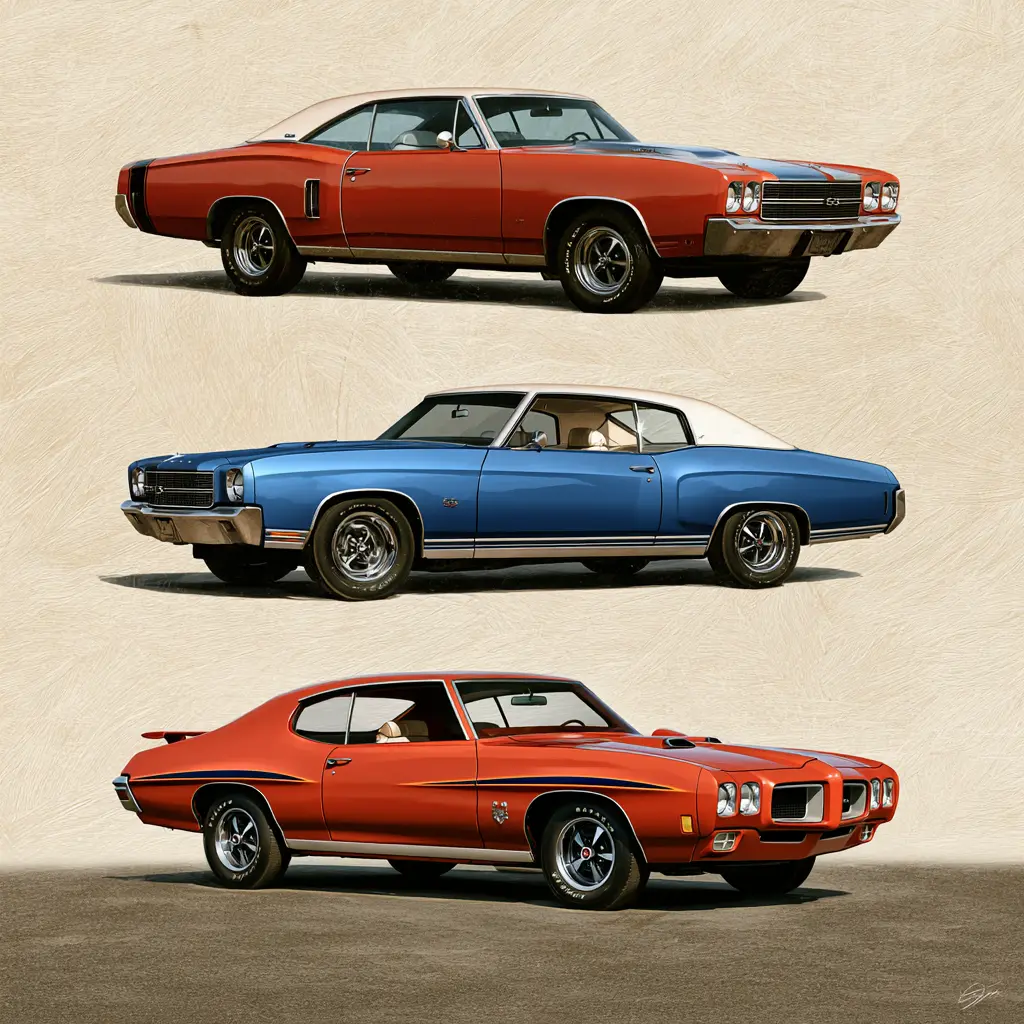
The first-generation Monte Carlo SS 454 was built on the same A-body architecture as the Chevelle, with the same LS5 454 under a longer hood. Chevrolet aimed it at a buyer who wanted the performance without the stripes — a personal luxury coupe that could embarrass a Chevelle at a stoplight while its owner sat in nicer seats. Only 3,823 Monte Carlos received the SS 454 package in 1970, out of roughly 146,000 built. The package was dropped entirely after 1971.
So: same engine, same platform, meaningfully rarer. And Hagerty’s own analysts describe it plainly as a muscle car bargain, noting a #2 value around $34,100 against roughly $61,600 for an equivalent LS5 Chevelle SS 454. Their valuation specialist’s summary is the one I keep coming back to: you get “pretty much the exact same experience for a whole lot less money.”
The reason for the discount is almost entirely aesthetic and generational. The Monte Carlo’s later years — the enormous, soft, opera-windowed 1973–77 cars — poisoned the nameplate’s reputation with collectors who did not distinguish between generations. The 1970 car has nothing to do with those cars. It just shares a name.
Rarer, equally fast, roughly half the money. I do not know how much longer that holds.
The Wrong Model Year: 1971–1973 Ford Mustang Mach 1
This is the category that requires the most nerve, because you are buying against a genuine and widely held prejudice.
The 1971–73 Mustang is the big one — longer, wider, heavier, with a near-horizontal rear glass that made backing out of a driveway a leap of faith. It arrived exactly as compression ratios were falling, insurance surcharges were biting, and the industry was quoting net rather than gross horsepower. Enthusiasts have spent five decades treating it as the moment the Mustang lost its way.
I think that is a story about timing, not about cars. The 1971 Mach 1 with the 351 Cleveland four-barrel is a legitimately quick, exceptionally good-handling car — the Cleveland’s canted-valve heads flowed better than almost anything Ford had built, and the wide track gave it a stability the earlier cars never had. The Boss 351 version is one of the finest small-block Mustangs ever produced, full stop.
And these cars sit at a fraction of 1969–70 Mach 1 money, in some configurations at less than a third. Meanwhile the parts supply is excellent, the community documentation is deep, and the cars are large enough that an adult can actually drive one across a state without physical therapy afterward. If you are planning something like the great American muscle car road trip, the 1971 car is a considerably more pleasant companion than the 1965.
The generational argument is straightforward. The buyers who formed their opinions of the Mustang in 1969 are aging out of the market. The buyers replacing them did not live through the disappointment and have no particular reason to inherit it.
The Wrong Decade: The 2004–2006 Pontiac GTO
Now to the one that irritates purists, and the one I am most confident about.
The last GTO was a Holden Monaro with a Pontiac badge, built in Australia and sold in America to almost nobody. The 2005–06 cars carried the LS2 — 400 horsepower, six-speed manual available, a chassis that was arguably the best-balanced thing Pontiac ever put underneath a V8. It was also visually anonymous, which is precisely why it failed at the dealership. Buyers expecting hood scoops and stripes got a shape that looked like a rental car.
Twenty years later, the fifth-generation GTO market on Classic.com shows an average sale price of roughly $21,880, with recorded sales running from about $6,599 up to $41,000. Four hundred horsepower, a real manual transmission, an LS engine with the deepest aftermarket support of any V8 in history, and a production run so short the cars are genuinely scarce — for the price of a used commuter sedan.
Every generation of collector eventually decides that the cars of its own youth were the good ones. The 2004–06 GTO, the Fox-body Mustang GT, and the 2008–09 Pontiac G8 GXP are all sitting in that pre-recognition window right now. The GTO is the one where the engineering most exceeds the reputation.
A Note on the Nameplates You Already Know
Not every bargain requires courage. The Mercury Cougar is the honest middle ground — a Mustang platform with better materials, a longer wheelbase, and sequential taillights, wearing a badge that Ford’s own marketing spent decades positioning as the sensible choice. I covered its history in detail in my post on the Mercury Cougar’s place in American automotive history, and the valuation gap versus an equivalent Mustang remains one of the more persistent inefficiencies in the Ford world.
The broader market context matters here too. I have written before about the declining muscle car market and whether it represents opportunity or warning, and my view has not changed: a cooling market is a problem for speculators and a gift to enthusiasts. Softness at the top of a market has a way of pulling attention downward, toward exactly the cars listed above.
Buy the Car, Not the Thesis
One caution before you start browsing listings at midnight.
Every car on this list is undervalued relative to a comparison car. None of them is undervalued relative to a bad example of itself. A rusty Super Bee with a swapped drivetrain is not a bargain at any price — it is a restoration project wearing a sales listing, and restoration projects have a way of consuming budgets that were never authorized. If you are considering one, read my complete guide to first-time muscle car restoration projects first and price the work honestly before you price the car.
The discipline is simple, and it is the same discipline that applies to any asset: buy the best-documented, most original example you can afford, in the least ambitious condition tier you can live with, and drive it. The cars on this list are cheap because of stories the market tells about them. Stories change. Sheet metal, documentation, and a numbers-matching engine do not.
That is really the thread running through everything I collect. The 1970 Monte Carlo SS and a discontinued LEGO set and a pair of Jordans nobody wanted in 1998 are all the same trade at heart — you are buying the thing before the consensus arrives, and you are enjoying it in the meantime. I have written more about that habit of mind across my collections site, where the muscle cars share space with the sneakers, the Ushio Shinohara paintings, and the bricks, and on my main site, where the LEGO and koi pond obsessions live.
It is also, I will admit, the least important thing I do. The work that actually matters happens through the Savage-Rivera Foundation, which my wife Sandra and I founded to support families living in poverty in Honduras. Cars are a hobby. That is the point of the hobby — it is supposed to be the part of life that does not have to justify itself, so long as the rest of it does.
You can find more of what I am looking at, saving, and occasionally regretting on my Pinterest boards.
Mike Savage of New Canaan, CEO of 1-800Accountant, founder of Savage-Rivera Foundation, has been collecting and driving American muscle cars for more than two decades. He writes about muscle car history, restoration, and the collector market here, and about his other pursuits — LEGO, koi ponds, sneakers, art, and travel — across his other sites.